

Research area
Root Cause Analysis & AIOps
How can we turn operational telemetry into reliable diagnosis and actionable incident response?
We acknowledge the support of Bell Mobility and the Natural Sciences and Engineering Research Council of Canada (NSERC) under grant ALLRP614128-25.


10 researchers in this area · 50 publications · 0 data sets
From telemetry to root causes
A failure in one service can surface as errors, slowdowns, or unusual resource usage elsewhere. Root cause analysis (RCA) connects these symptoms to the underlying fault. Doing so requires reasoning across heterogeneous telemetry and the dependencies between services.
We study how AI for IT operations (AIOps) can help engineers move from detecting an anomaly to understanding a failure and deciding what to do next. Our research brings together statistical analysis, graph structure, and LLM agents, with an emphasis on diagnoses and repair decisions grounded in operational evidence.
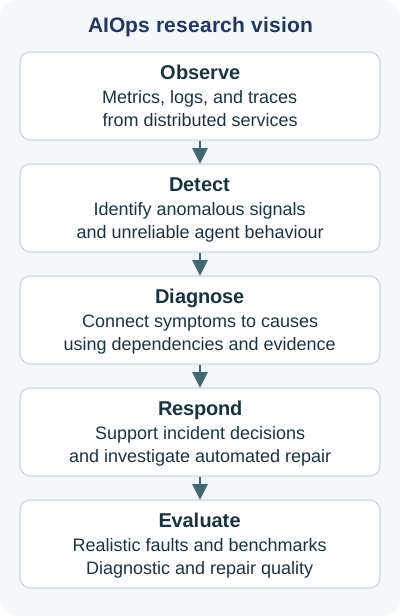
Research vision: connect operational evidence to diagnosis and response, and evaluate each step in realistic systems.
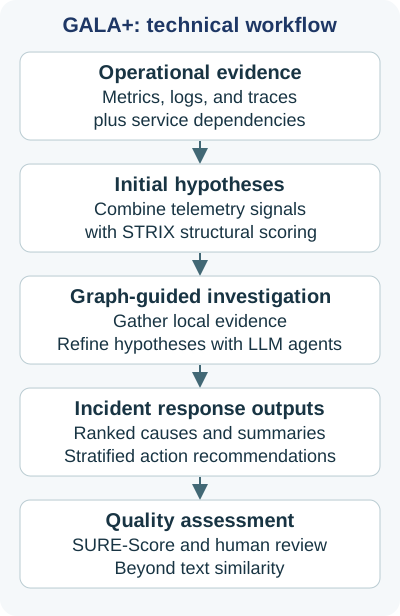
Technical example: GALA+ uses service dependencies and local telemetry to guide LLM investigation; SURE-Score assesses the quality of its outputs.
Graph-guided diagnosis and incident response
GALA, whose updated framework is called GALA+, uses service dependencies to guide LLM agents through local metrics, logs, and traces. It produces ranked diagnoses, incident summaries, and action recommendations. SURE-Score, developed with industry site reliability engineers, assesses diagnostic quality beyond text similarity.
Message-level anomaly detection
Effective investigation starts with finding useful signals in large volumes of telemetry. FAME studies anomaly detection at the level of individual log messages. It uses an LLM during offline preparation to help organize failure domains, then trains a lightweight router and specialized experts for online detection with limited labeling effort.
Telemetry-grounded repair
Diagnosis can also provide context for changing code and configuration. ORCA compares failure and reference telemetry to build a fault signature, locate candidate repair sites, and guide patch generation. Its verification process examines patch correctness, test integrity, and telemetry replay to connect automated repair with the incident that motivated it.
Reliable agents and realistic evaluation
AI agents are both tools for incident response and systems whose own failures need diagnosis. AgentChaosBench studies fault detection and localization from agent execution telemetry, including faults at tool, model, guardrail, and inter-agent boundaries.
SREGym evaluates SRE agents in live cloud-native environments with injected faults and ambient noise. These complementary settings help us examine whether an agent can identify a fault, locate its origin, and support incident resolution under realistic operating conditions.
GF-Bench extends failure detection to distributed GPU workloads, while SRE-Marathon studies continuous operation with overlapping incidents and code or configuration changes.
Current directions
- Correlating metrics, logs, and traces across service dependencies
- Graph-guided and evidence-grounded LLM investigation
- Connecting root cause diagnosis to remediation and automated repair
- Evaluating diagnostic quality, agent reliability, and operational usefulness
This research connects with our work in Data Management. We also continue research in distributed AI and machine learning, including resource allocation and scheduling for training and inference, privacy-preserving and federated learning on embedded and edge devices, and scalable graph processing and graph neural networks.
Research outcomes
AgentChaosBench
Fault-detection and localization evaluation tools with 275 execution traces from five agentic applications.
FAME
Message-level log anomaly detection using offline failure-domain grouping and a lightweight router with specialized experts.
GALA evaluation artifacts
Annotated incident reports, example outputs, a supplementary technical report, and third-party baseline frameworks. The core GALA implementation is not publicly released.
SRE-Marathon project website and leaderboard
Project website and paper-reported leaderboard for continuous, change-driven SRE evaluation. Its GitHub repository contains the website source, not the benchmark implementation.
SREGym
A live cloud-native benchmark for evaluating how SRE agents diagnose and mitigate injected operational failures.
GF-Bench artifacts
Tools for generating multi-GPU failures, collecting NCCL logs, and evaluating anomaly detection, with sample data and scripts to reproduce the experiments.
Recent publications
Recent publications in root cause analysis, AIOps, and our broader distributed AI and machine learning research.
Shivesh Prakash / Nandan Patel / Hans-Arno Jacobsen / Viki Kumar Prasad
A user-tunable machine learning framework for step-wise synthesis planning
Digital Discovery, 2026
Chenkai Zhang / Yiran Li / Yifang Tian / Michail Bachras / Hans-Arno Jacobsen
AgentChaosBench: Benchmarking External Fault Detection and Localization in Agentic Systems
Proceedings of the 1st International Workshop on Trustworthy and Responsible aUtonomous SysTems (TRUST '26), pp. 75–82, 2026
Jana Vatter / Ruben Mayer / Hans-Arno Jacobsen / Horst Samulowitz / Michael Katz
Beyond Message Passing: Modern GNN Architectures for Online Planner Selection
Proceedings of the International Conference on Automated Planning and Scheduling, 2026
Nikolai Merkel / Ruben Mayer / Volker Markl / Hans-Arno Jacobsen
EmbedPart: Embedding-Driven Graph Partitioning for Scalable Graph Neural Network Training
arXiv, 2026
Huanchi Wang / Zihang Huang / Yifang Tian / Kristina Dzeparoska / Hans-Arno Jacobsen / Alberto Leon-Garcia
FAME: Failure-Aware Mixture-of-Experts for Message-Level Log Anomaly Detection
37th IEEE International Symposium on Software Reliability Engineering (ISSRE), 2026
Yifang Tian / Yaming Liu / Zichun Chong / Zihang Huang / Yiran Li / Hans-Arno Jacobsen
GALA: Graph-Augmented LLM Agents for Root Cause Analysis and Incident Response in Microservices
Proceedings of the 41st IEEE/ACM International Conference on Automated Software Engineering (ASE '26), pp. 55–67, 2026
Researchers in this area
Current and visiting MSRG members associated with our AIOps and distributed AI/ML research are shown below. View the full MSRG team.
Professor

Post-Docs

Graduate Students PhD


